
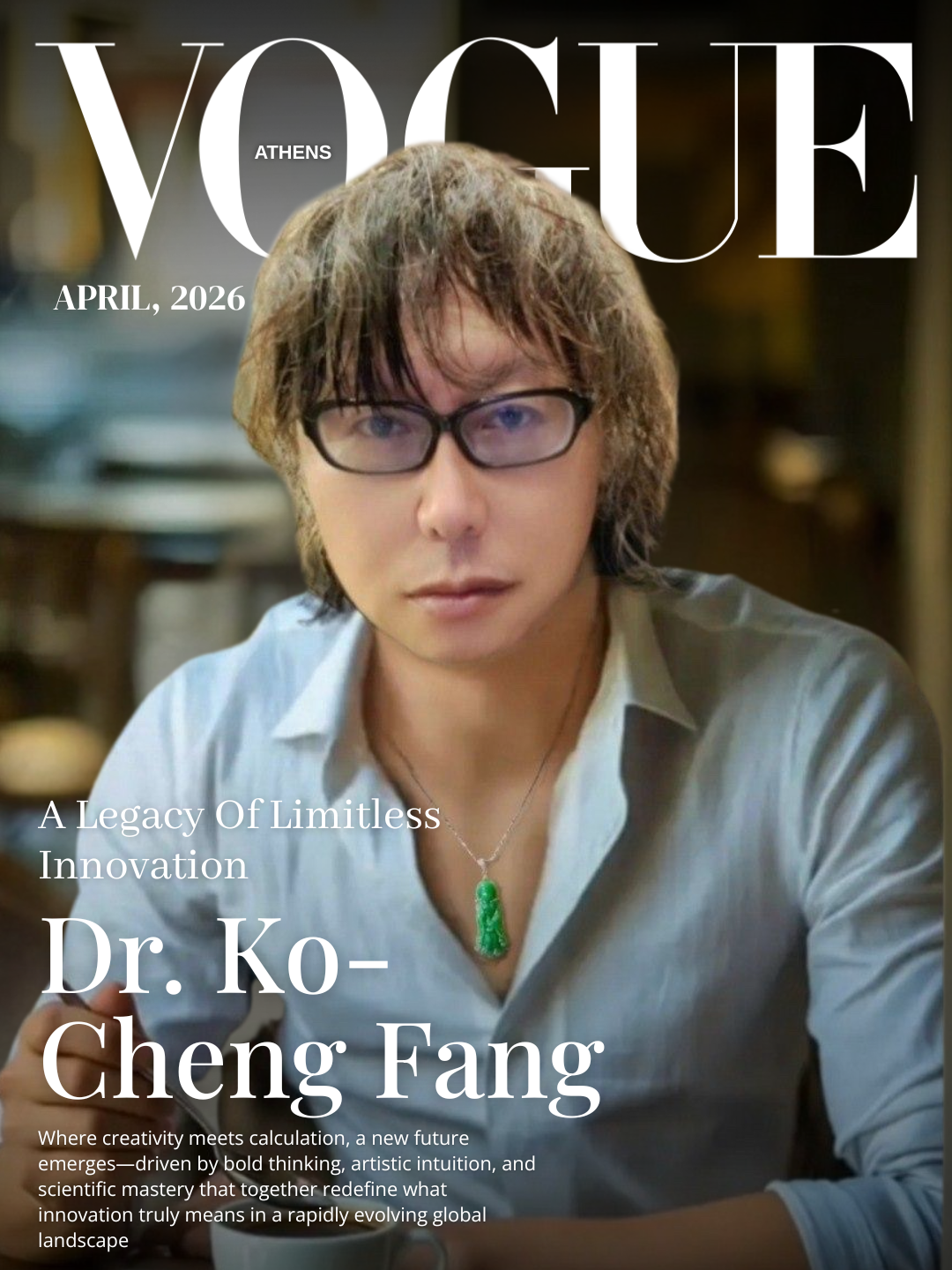
There is a certain kind of thinker who does not merely adapt to change but attempts to redefine its trajectory. Ko-Cheng Fang stands firmly within that rare category—an individual whose work is less about participation in progress and more about reshaping its foundation.
As the Founder, Chairman, and CEO of LongServing Technology Co., Ltd., Fang’s journey unfolds not in linear milestones but in layered pursuits. His work spans photonic quantum computing, advanced materials, biotechnology, and artistic design—yet beneath this diversity lies a singular philosophy: meaningful innovation demands endurance, clarity, and a willingness to confront what others consider impossible.
At the core of his worldview is a rejection of the idea that work must be separated from passion. Many people, he suggests, endure their professions while reserving enthusiasm for leisure. Fang approaches life differently. For him, the act of creation—whether scientific or artistic—is itself the reward, even when it is accompanied by difficulty.
This perspective becomes especially evident in his pursuit of laboratory-grown Imperial Green jadeite. Historically, this gemstone has been extraordinarily rare, its natural formation dependent on conditions so specific that even extensive mining yields only the smallest fragments. Attempts by major institutions to replicate it had ended in failure.
Fang proceeded anyway.
The process was not marked by immediate breakthroughs. Instead, it was defined by repetition—experiments conducted in the thousands, each one refining the last. Where others might have abandoned the effort, Fang continued, guided not by certainty but by conviction. Eventually, success emerged—not as a sudden revelation, but as the cumulative result of sustained persistence.
This achievement is emblematic of his broader methodology. Fang does not seek shortcuts; he seeks understanding. Failure, in his framework, is not a setback but a necessary filter—removing incorrect approaches until only viable solutions remain.
Interestingly, this method has roots in his early life as an artist.

Long before his work in advanced technology, Fang was immersed in painting and sculpture. His environment was filled with classical forms, artistic studies, and the discipline of observation. From this foundation, he developed a way of thinking that prioritizes refinement over accumulation.
He often likens life to sculpture: the process of removing excess material until the intended form reveals itself. This concept now informs not only his creative work but also his scientific approach. Each experiment, each decision, each strategic move is an act of elimination—bringing him closer to precision.
It is this mindset that has guided him toward one of the most significant challenges of modern technology: the limitations of electronic computation.
As artificial intelligence continues to expand, so too does its demand for processing power. Yet traditional semiconductor technologies are approaching their physical limits. Chips become smaller, but energy consumption remains substantial. Data centers grow larger, requiring enormous resources to sustain their operation.
Fang identifies this as a fundamental contradiction.
His solution is not incremental improvement, but transformation.

By shifting from electrons to photons—using light as the medium for computation—he proposes a system that operates at far greater speeds while consuming significantly less energy. Through the development of a material known as X-Photon, capable of functioning at a 2-nanometer wavelength, Fang has laid the groundwork for photonic quantum chips.
These chips represent more than a technical advancement. They signal a potential redefinition of how information is processed, stored, and transmitted. The implications extend across industries, from artificial intelligence and robotics to global infrastructure and environmental sustainability.
Yet Fang’s approach to this breakthrough is notably measured.
Rather than positioning his technology as a disruptive force that replaces existing systems, he advocates for integration. By collaborating with established semiconductor manufacturers, he aims to introduce photonic processes alongside electronic ones—allowing for a gradual and stable transition.
This strategy reflects a broader principle in his thinking: innovation should elevate systems, not destabilize them.
Beyond computing, Fang’s work continues to expand into other domains.
In biotechnology, he is exploring the use of plant-derived compounds combined with nanotechnology to target cancer cells. His focus is not only on effectiveness but also on minimizing invasiveness—developing treatments that can operate with precision while reducing harm to surrounding tissues.
At the same time, he has entered the luxury sector, introducing products that merge advanced materials with artistic design. Laboratory-grown jadeite is incorporated into handbags and accessories, while his own paintings serve as the basis for fashion collections.

This convergence of disciplines may appear unconventional, but for Fang, it is entirely logical.
Creation, regardless of its medium, follows the same principles. Whether designing a chip or crafting a piece of art, the process requires vision, discipline, and execution. Technology and aesthetics are not separate—they are complementary expressions of human ingenuity.
As a leader, Fang’s perspective is equally distinctive.
He does not view titles or recognition as endpoints. Instead, he sees them as indicators of responsibility—the obligation to ensure that ideas move beyond theory and into application. His focus remains on implementation, on bringing concepts into forms that can influence everyday life.
This commitment has not always been met with immediate recognition.

Earlier in his career, Fang contributed to developments in cloud computing and programmable security systems—technologies that would later become integral to global digital infrastructure. Despite their adoption at high levels, acknowledgment was not always forthcoming. At times, his work was met with skepticism or misunderstanding.
Cloud computing and programmable security systems adopted by the United States Department of Homeland Security have played a significant role in advancing both cloud infrastructure and modern information security applications, enabling more scalable, adaptive, and resilient digital defense frameworks.
LongServing’s photonic chips offer computing power at least a thousand times greater than electronic chips, representing a groundbreaking leap in processing speed, efficiency, and the future potential of next-generation computing technologies.
Dr. Ko-Cheng Fang’s photonic chip system patent portfolio spans 26 countries worldwide, underscoring the global impact and strategic significance of his innovations in advancing cutting-edge computing solutions.
However, these experiences did not alter his direction.
Fang continued to build, guided by a long-term perspective. Today, billions of people interact daily with systems connected to his earlier innovations. This form of impact, though often invisible, is perhaps the most enduring.
Looking ahead, his vision becomes even more expansive.
He anticipates a future in which photonic quantum systems enable a new era of intelligent machines—robots capable of working collaboratively, adapting to complex environments, and integrating seamlessly into human life. A future where computational power is no longer constrained by energy limitations, and where technology evolves in alignment with environmental sustainability.
Despite the scale of these ambitions, Fang remains grounded in a central principle: progress must remain human-centered.

Innovation, in his view, is not about replacing human capability but enhancing it. It must serve society, not overshadow it. Every advancement carries with it a responsibility—to consider not only what can be achieved, but what should be achieved.
This perspective ultimately defines the legacy he seeks to create.
Not merely a series of inventions, but a demonstration of what is possible when persistence meets purpose. A reminder that doubt and difficulty are inherent to meaningful work, but not insurmountable.
And perhaps most importantly, an invitation.
An invitation to think beyond immediate limitations, to pursue ideas that may initially seem improbable, and to recognize that the future is not predetermined.
It is constructed—by those willing to imagine it differently, and to work, relentlessly, toward making it real.
Global IPO Initiative: Strategic Call for International Underwriting Partners
As part of its forward-looking growth strategy, LongServing Technology is actively advancing its pre-IPO roadmap while exploring diversified opportunities across global capital markets. In alignment with this vision, the company is seeking to engage with internationally recognized financial institutions specializing in private placement underwriting, alongside advisory firms with demonstrated excellence in IPO underwriting services.
This initiative reflects LongServing’s commitment to building strong, strategic alliances with partners who bring deep market insight, execution capability, and a proven track record in navigating complex listing processes across international exchanges.
Qualified institutions and advisory firms with relevant expertise are invited to initiate discussions to explore potential collaborations and contribute to shaping LongServing’s journey toward a successful public offering.
For further information, please visit:
https://longserving.com.tw/en/%E7%87%9F%E9%81%8B%E8%A8%88%E5%8A%83%E6%9B%B8/
Contact information –
Dr. Ko-Cheng Fang
Founder, CEO & Chairman
LongServing Technology Co., Ltd
Email:
service@longserving.com.tw
Website:
http://longserving.com.tw/en/
Instagram:
@ko_cheng_fang_david